
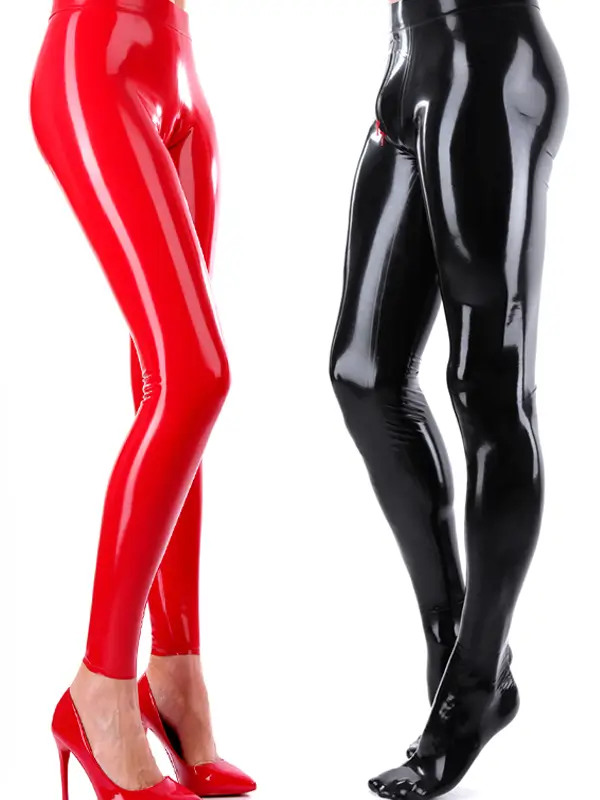


Latex thicknesses: Which thickness offers the best comfort?
Latex clothing is available in a range of thicknesses. These range from very thin latex at 0.25 mm to significantly thicker materials at 0.50 or 0.60 mm and above. But which thickness is actually the right one? Many people initially assume that thicker latex must automatically be more robust, of higher quality and more durable. When worn, however, it quickly becomes apparent that the thickness of the material has a crucial influence on stretchability, fit and comfort.
This is why, particularly when latex clothing is to be worn for long periods, the thickest material is not necessarily the best choice. What matters far more is what properties you are looking for in a latex catsuit, latex leggings, latex trousers or any other item of clothing.
At Simon O., we have been working with latex for many years and know the different properties of the materials from our day-to-day experience. In this guide, we explain what difference the various latex thicknesses actually make and why 0.25 mm and 0.40 mm latex are particularly comfortable for many wearers.
How important is the thickness of the material in latex clothing?
The thickness of latex is measured in millimetres. Common thicknesses for latex clothing include , for example , 0.25 mm, 0.40 mm, 0.60 mm or even thicker.
A higher number simply means that the latex material is thicker. However, this does not automatically mean that a garment is better or worse.
This is because as the thickness of the material increases, various properties of the latex change:
- its elasticity
- the feel when putting it on
- how well it moulds to the body
- freedom of movement
- the weight of the garment
- how it feels when worn
That is why the choice of latex thickness should always be based on how the garment is to be worn and for how long.
For bondage items such as bondage foot cuffs, straps or corsets, a material thickness of over 2 mm is, of course, required. This can often only be achieved by double-layering the material.

0.25 mm or 0.40 mm latex – which thickness feels better?
For many people , 0.25 mm and 0.40 mm latex are the most comfortable thicknesses for latex clothing.
The difference between these two thicknesses is noticeable when worn, but both materials offer a very good combination of stretch, fit and that typical snug latex feel.
0.25 mm latex
0.25 mm latex is pleasantly thin yet very stretchy, allowing the material to mould perfectly to the body’s shape. A real pleasure to wear. The latex lies close to the body without feeling unnecessarily stiff. This creates a very close-fitting and comfortable feel, particularly with a latex catsuit or a shirt.
Its high elasticity is also an advantage during movement. The material can stretch more, allowing it to adapt better to the body’s movements.
0.40 mm latex
0.40 mm latex feels slightly sturdier and more substantial. It offers a little more resistance and is more noticeable when worn. At the same time, 0.40 mm latex still has very good elasticity and ensures a comfortable fit.
For many wearers, 0.40 mm is therefore a very good compromise between comfortable stretch, a close-fitting feel and slightly greater durability.
How stretchy is 0.25 mm latex compared to thicker latex?
Generally speaking, the thinner the latex material, the more easily it can stretch.
0.25 mm latex is therefore particularly flexible and adapts very well to different body shapes and movements.
0.40 mm latex offers slightly more resistance. It therefore feels sturdier, but also has very good stretchability.
0.60 mm latex offers a distinctly noticeable resistance. It therefore feels very sturdy and is not quite as stretchy.
This property is particularly crucial for garments that need to fit snugly against the body.

Who is 0.25 mm thin latex suitable for?
0.25 mm latex is particularly suitable for people who value maximum comfort, high elasticity and a particularly close-fitting cut. Thanks to its high elasticity, this thin material adapts very well to different and less-than-ideal body shapes and is forgiving of minor problem areas.
Another advantage of 0.25 mm latex is that the garment can be made slightly smaller. This creates an exceptionally tight fit, with the latex moulding perfectly to the body and forming significantly fewer creases.
It is particularly popular for outfits used in film or photo shoots.
Women in particular love this thickness, as it guarantees a skin-tight fit whilst still being comfortable to wear.
The thickness of the material is of interest to anyone who wishes to wear latex not just for a short time, but for several hours at a time. The material’s high flexibilityis a major advantage , particularly with close-fitting garments such as latex catsuits, latex leggings, latex tights or latex shirts .
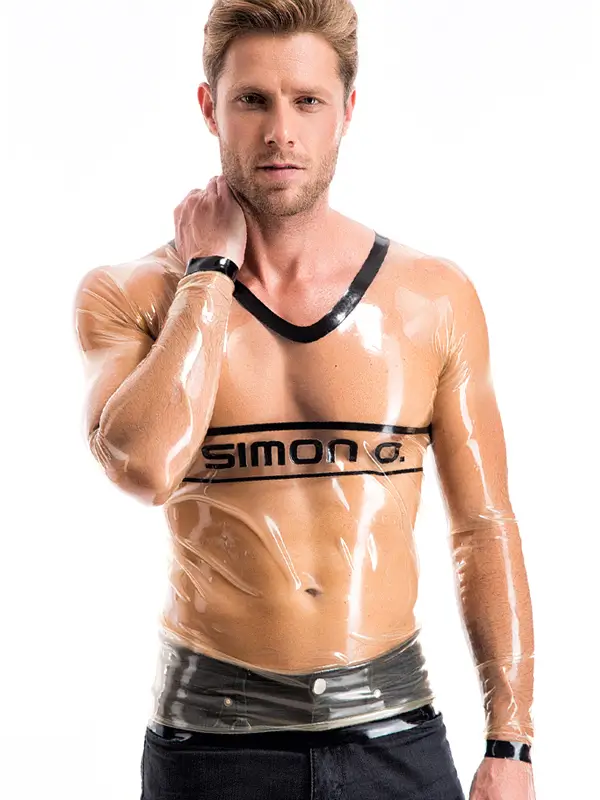
With a material thickness of 0.25 mm, transparent colours really come into their own. The transparency is significantly more intense and clearer than with thicker latex materials.
Even for people wearing latex clothing for the first time, 0.25 mm is an interesting choice. The material feels less stiff and less restrictive than significantly thicker latex.

Is thin latex really more delicate and does it tear more easily?
There is a widespread misconception here.
Thinner latex does not automatically mean that a garment is significantly more delicate or less durable.
Of course, 0.40 mm latex has a certain advantage over 0.25 mm latex when it comes to abrasion, due to its greater thickness. In practice, however, the difference is often much smaller than one might initially assume.
For example, if a sharp-edged object damages the latex, both 0.25 mm and 0.40 mm latex can tear.
By contrast, the greater elasticity of 0.25 mm latex can actually be an advantage under many types of strain. The material can stretch further and mould itself better to the body. It is therefore not just the millimetres that determine the lifespan of a latex garment.

Why can thinner latex provide a better fit?
Latex clothing thrives on its close-fitting design. The material should hug the body as closely as possible whilst still allowing for movement.
Thanks to its high elasticity , 0.25 mm latex adapts particularly well to different parts of the body. It is often possible to choose a smaller size, thereby achieving a particularly snug look. When bending, stretching or sitting, the material can stretch more and then return to its original shape.
This creates a very pleasant sensation on the skin whilst also giving you that characteristic feeling of being completely enveloped in latex . Naturally, a good fit also depends on the cut and choosing the right size. The thickness of the material alone cannot compensate for a poorly fitting cut.
Why do manufacturers generally prefer to use 0.4 millimetres of latex?
Let’s take a latex catsuit as an example and compare 0.25 millimetre with 0.4 millimetre material. Even when both catsuits are laid side by side, a clear difference can be seen. The catsuit made from 0.4 millimetre latex looks sturdier, lies snugly and compactly, and has more volume.
The particularly fine 0.25-millimetre latex, on the other hand, gives a much lighter impression. The catsuit is less bulky, lies flatter against the body and appears overall more delicate and refined. When comparing them side by side, many customers therefore initially think: ‘The 0.4-millimetre catsuit must be of higher quality. It’s thicker, sturdier and feels more luxurious.’ You get more for your money!
However, this is a fallacy.
In fact, the opposite is true: the thinner the latex, the more demanding the manufacturing process. Thin latex is more prone to curling, must be positioned more carefully during processing, and requires a great deal of experience and skill when bonding. That is why producing a high-quality garment from 0.25-millimetre latex is particularly challenging. Staff need a great deal of experience, a delicate touch and a very precise way of working.

Thicknesses of 0.4 to 0.5 millimetres are particularly easy to work with
With latex that is 0.4, 0.5 or 0.6 millimetres thick, processing is significantly easier and less delicate across many stages of the process. The material is more stable, easier to handle and can be processed more quickly and efficiently.
This is precisely one of the main reasons why manufacturers tend to opt for a material thickness of 0.4 or 0.5 millimetres when producing bonded latex garments. These thicknesses offer an excellent balance between stability, ease of processing and comparatively low production costs.
Why 0.25 millimetres requires significantly more experience
With 0.25-millimetre latex, the situation is quite different. This thin material is considerably more difficult to produce and requires a great deal of experience, finesse and care. It stretches more and is more prone to curling when the adhesive is applied. This results in a significantly greater time investment. A high-quality 0.25-millimetre catsuit is therefore more complicated to manufacture than a catsuit made from 0.4 or 0.5-millimetre latex.
Even very thick latex can increase the amount of work involved!
With very thick latex – for example, 0.8 millimetres or more – the amount of work involved also increases again. Although the material can generally be bonded easily and securely, the bonded seams often need to be reinforced depending on the design . For this purpose, additional reinforcement strips made of thinner latex can be used, for example. These extra steps, in turn, increase the time required for production.
A garment made from thin latex is not cheaper, but rather more expensive
The thickness of the material alone says nothing about the quality of a latex garment.A high-quality 0.25-millimetre catsuit requires significantly more craftsmanship and labour than a comparable model made from 0.4 or 0.5-millimetre latex, due to its more intricate workmanship .
Thinner does not, therefore, mean inferior. On the contrary, thin latex places particular demands on material knowledge, experience and craftsmanship.
Why do some people prefer particularly thick latex, and how does it feel?
As the thickness of the material increases, the feel when worn changes significantly.
0.50 mm and, in particular, 0.60 mm latex feels considerably stiffer, heavier and less flexible than 0.25 mm or 0.40 mm.
This may well be desirable.
There are latex wearers who prefer precisely this sturdy and distinctly noticeable material. They deliberately want to experience the sensation that the latex gives way less and has a stronger presence against the body.
That is why thick latex is by no means inherently inferior. It is simply different.
Personal preference plays a major role in choosing the thickness of latex.
Whilst some wearers prefer latex that is as thin and flexible as possible, others deliberately seek out a sturdier material.
At 0.50 or 0.60 mm or thicker, there is a noticeably stronger feeling of being constricted. The material is sturdier and yields less when you move.
This characteristic can certainly be of interest for certain items of clothing or specific applications.

Why can very thick latex become uncomfortable when worn for long periods?
This is precisely where the difference between wearing it for a short time and wearing it for several hours becomes particularly apparent.
With very thick latex – for example, 0.60 mm or more – the material is less able to give way when parts of the body are bent.
This can become uncomfortable during prolonged wear, particularly at the elbows, the crooks of the arms, the knees and the backs of the knees. The material can press more firmly against the skin and, when the body is bent, can actually cut into the skin.
This can significantly reduce comfort when worn for extended periods.
Thinner latex can adapt more effectively to movement in these areas and therefore often offers a much more comfortable fit.
What thickness of latex is suitable for prolonged wear?
If comfort over a longer period is a priority, we generally recommend 0.25 mm or 0.40 mm latex.
Both thicknesses combine excellent stretch with a close-fitting cut.
The 0.25 mm option is particularly flexible and lightweight. The 0.40 mm option offers slightly more material and support, whilst remaining comfortable and sufficiently stretchy.
For many latex wearers, these two thicknesses therefore represent the best compromise between a close-fitting feel, freedom of movement, comfort and that typical latex sensation.
What thickness of latex gives the feeling of being completely enclosed by it?
The sensation of being completely enclosed does not necessarily depend on the latex being particularly thick.
A 0.25 mm latex catsuit can convey this typical sensation very intensely.
The key difference is that thin latex moves more closely with the body. It lies directly against the skin and follows your movements, rather than restricting the body with a very stiff material.
So, if you love the feeling of being completely encased in latex, but at the same time value freedom of movement and high comfort, you’ll find 0.25 mm or 0.40 mm latex to be a particularly interesting combination.

What latex thickness do we at Simon O. recommend?
Based on our many years’ experience with latex clothing, we consider 0.25 mm and 0.40 mm to be particularly versatile and comfortable thicknesses.
If you’re looking for a garment that feels as light, flexible and close-fitting as possible, 0.25 mm latex is an excellent choice.
If you prefer a slightly thicker material and a firmer feel, whilst still wanting a high level of comfort, you can opt for 0.40 mm latex.
0.50 mm and 0.60 mm latex, on the other hand, are more suited to people who deliberately prefer a firmer material that is more noticeably substantial.
There is therefore no single ‘best’ latex thickness that suits everyone equally. The decisive factors are your personal preference for how the garment feels, and how long and for what purpose the latex garment is to be worn.
Conclusion: Thin or thick latex – which is better?
There’s no one-size-fits-all answer to this question.
If you’re looking for maximum comfort, high elasticity and a particularly close-fitting style, you’ll most likely be happy with 0.25 mm latex.
Those who prefer a slightly sturdier material whilst still wanting to be comfortable on the go will find 0.40 mm latex an excellent alternative.
0.50 and 0.60 mm latex also have their merits and are deliberately preferred by some latex wearers. However, for prolonged wear, these thicknesses can be significantly more demanding, particularly on parts of the body that move a lot.
And there’s one thing to bear in mind:
Thicker latex is not automatically better latex.
When it comes to comfort, fit and freedom of movement, thin latex in particular can offer significant advantages. Provided it is of good quality, carefully manufactured and properly looked after , even 0.25 mm latex can be exceptionally robust and durable.
Ultimately, choosing the right latex thickness is about finding your own balance between comfort, stretch, the feel of the material and the level of durability you require.
Even more inspiration
More blog posts

Latex thicknesses: Which thickness offers the best comfort?

Latex swimwear in public at the beach or pool - long accepted
